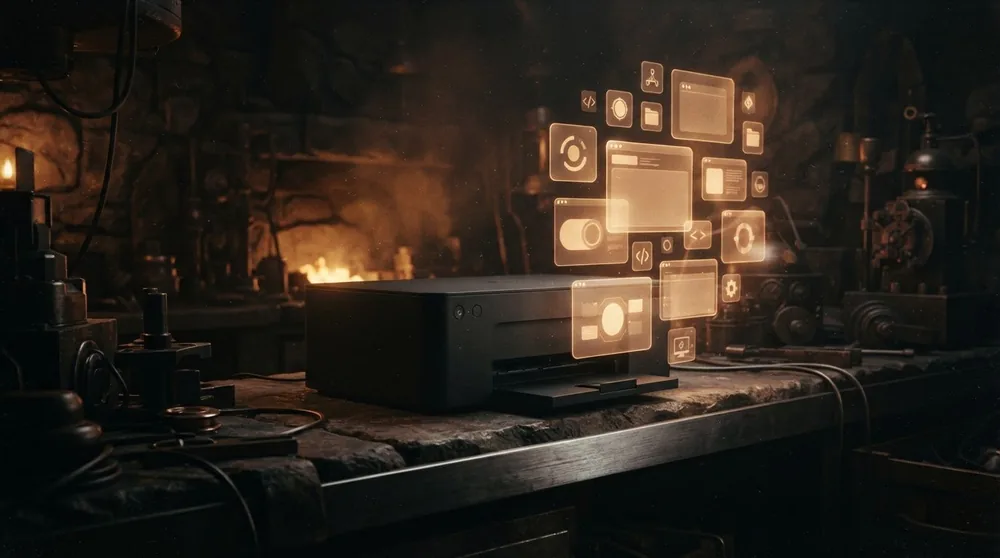
FIG 0 Software, not paper, coming out of the printer. Copying the output is the easy part.
In early October 2026, a developer published an open-source rebuild of Photoshop on GitHub. He says he built it in about nine days with an AI coding model. Other rebuilds of Adobe and Microsoft products followed.
The rebuilds are early. The developer’s claim of a near-perfect copy is a promise, not a result. But the question under the story applies to any AI product: if someone can copy what you built in a few weeks, what stops them?
A product that can be copied in a week has to win on something else
What a copy takes, and what it can’t
The PhotoCraft project says it copies menus, shortcuts and behaviour, built from public specifications. Its own README says it isn’t yet a tool for daily professional work. Even so, a rough copy of a familiar interface gets people to try it.
A copy takes the interface and the features. A hands-on review by How-To Geek found the same pattern. The clone looked remarkably like Photoshop, with the menus and layers in place, but users reported filters that didn’t produce the expected results. It doesn’t take your customers, your support, the files people already keep in your format, or the reason someone pays you instead of using the free version.
The project’s own estimate is that it covers about 45% of what a professional needs, according to a report from Declic in mid-October. That gap is real, and it is also the point. The hard part of a product was never the screens.
Imagine two bookkeeping tools with identical dashboards. One has a support team that answered your question last March. The other has never answered anyone. A buyer who has been burned once will pay for the first one, even if the second is free.
The old model: build it well and they will come
That advice held when building was slow
For years, shipping something that worked put you ahead of most of what existed. Building was the hard part, and the product did the marketing.
Building is now cheap. The advice hasn’t changed, but the world it described has. A working product no longer earns attention on its own.
The new model: what a copy can’t reproduce
Distribution: reaching people who already have the problem
A copy can’t reach your buyers. Only you have the list, the audience and the relationships built over months. If you don’t have people who are already looking for the problem, a better copy won’t find them either.
Trust: the reason to pay you instead of the free copy
A free copy has no track record. Buyers pay for proof that the product works for someone like them, and for a team that answers when something breaks. Case studies, named customers and direct support are slow to copy.
Positioning: the sentence that tells a buyer why this one
A clone can match your features but not your sentence. The question is whether a buyer can say, in one line, why your product fits their problem and why it’s worth paying for. If they can’t, the copy and the original look the same to them.
What to do this month
Check which of the three you have
Ask three questions. Who has this problem and knows you exist? What do people who use it say they’d miss if it disappeared? Can a stranger explain why your product, in one sentence? The earlier post on why your AI product has no users sets out how to test each one.
The projects in this story
Where each one stands, in its own words
Trademark note
Adobe, Photoshop, Illustrator, Premiere Pro, Lightroom, Acrobat, After Effects, InDesign, Microsoft Word, Excel and PowerPoint are trademarks of their owners. These projects are independent. Their developers say they are not affiliated with those companies. We show no logos from these projects, and the status lines come from the projects’ own descriptions.
The next question
Ask it before someone else does
If your product could be copied this month, the copy would still have to find its customers and earn their trust. That is the part we work on. If you want to know where your own product stands, start a conversation with us.